Dryer taking two cycles
In the large majority of cases this is a restriction rather than a failing machine. Two free checks below tell you which, before any money changes hands.
Check one: has it put up a code?
Start here, because it is the most reliable single indicator available and almost nobody is told about it.
A dryer showing a code is the duct roughly 95 percent of the time.
Current appliances detect this well. The control board tracks cycle duration against exhaust temperature, and when a restriction pushes those two out of agreement it posts a fault or ends the cycle early. Every manufacturer names it differently. The condition beneath the label never varies: the exhaust is not getting out of the building.
What usually happens next in a house like this is that somebody calls the appliance service the machine came with, pays for the visit, and is told the dryer is in perfect order and the duct is obstructed. Check the duct before paying anyone to open up a premium appliance.
It is worth knowing that high-end machines are not exempt from this. A well-built dryer in a well-built house still cannot push air through a forty-foot run that has not been opened since 2009.
Check two: the airflow test
Set the machine to air fluff, the no-heat option, and start it. Go to the outside termination and hold a hand near it.
Strong, steady flow. The duct is clear, cleaning changes nothing, and the fault sits inside the appliance. That is a repair technician's job.
Weak flow, or none. The duct is restricted, which is the whole of what we do, and it is $99.
If the termination is not somewhere you can reach, do it from inside. Draw the machine out, uncouple the duct behind it, and run one load with nothing attached. A load that dries normally that way points squarely at the duct. Open a window first.
Both checks take about two minutes between them and cost nothing. Do them before ringing anybody, ourselves included.
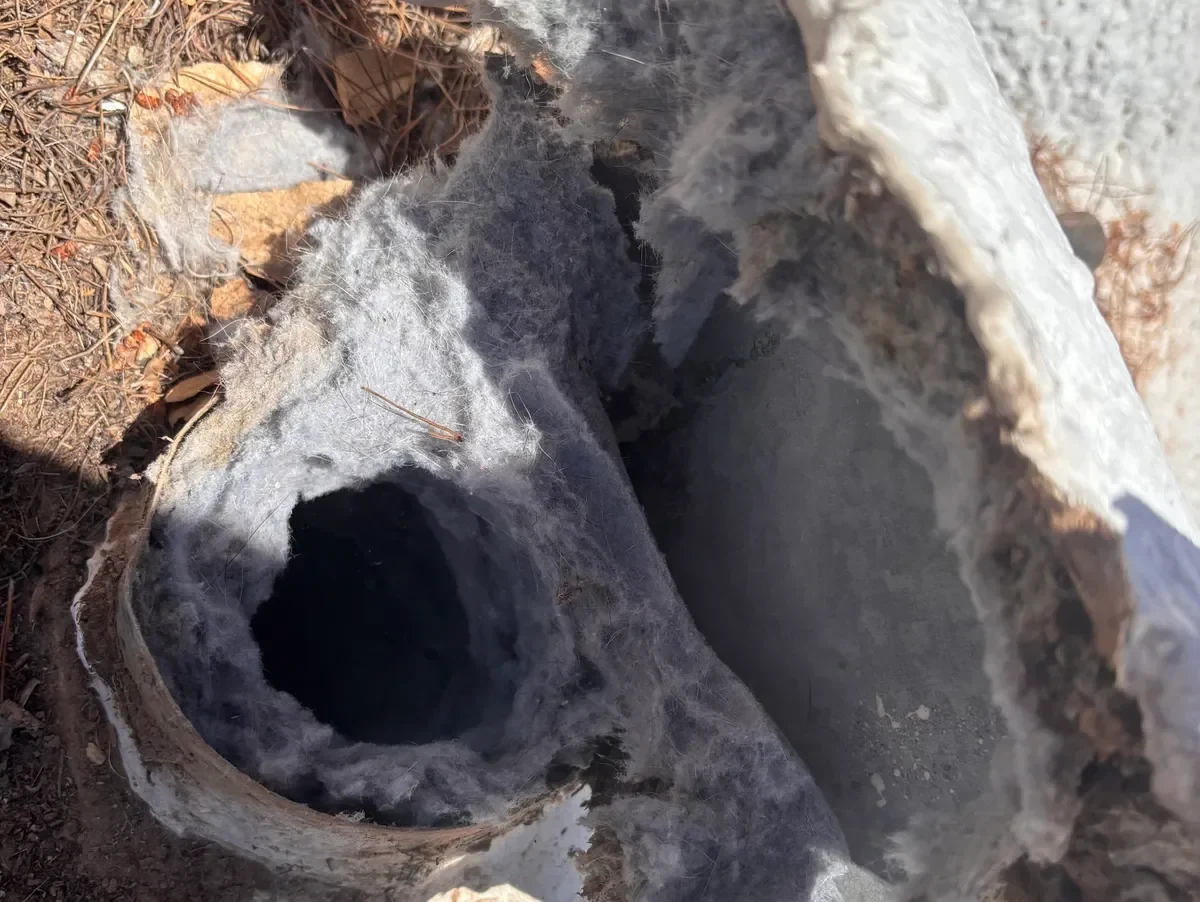
A good appliance does not exempt you
Worth addressing directly, because it comes up in this town more than anywhere else.
People spend a great deal on laundry equipment here and reasonably expect it to handle whatever it is connected to. It cannot. A very well-built dryer still has to move air through whatever duct exists beyond it, and forty feet of un-serviced run with four turns will defeat any machine ever made.
What build quality actually buys you is a longer survival time under the strain, plus better instrumentation, which is why premium machines are the ones most likely to post a code and tell you something is wrong. That is an advantage, provided somebody acts on it rather than calling appliance service.
If it is the duct, what is in there?
Length, before anything else
The first thing to consider in a house this size. A forty-foot horizontal run with four turns has essentially no tolerance, so it does not take much accumulation to produce a noticeable problem. It is also why these houses start showing symptoms earlier than their age would suggest.
Deposits in the middle of a horizontal run
Where the material actually collects on these properties. It does not slide back toward the appliance and it does not carry on to the termination. It settles mid-route, in the one position a brush fed from one end alone cannot reach.
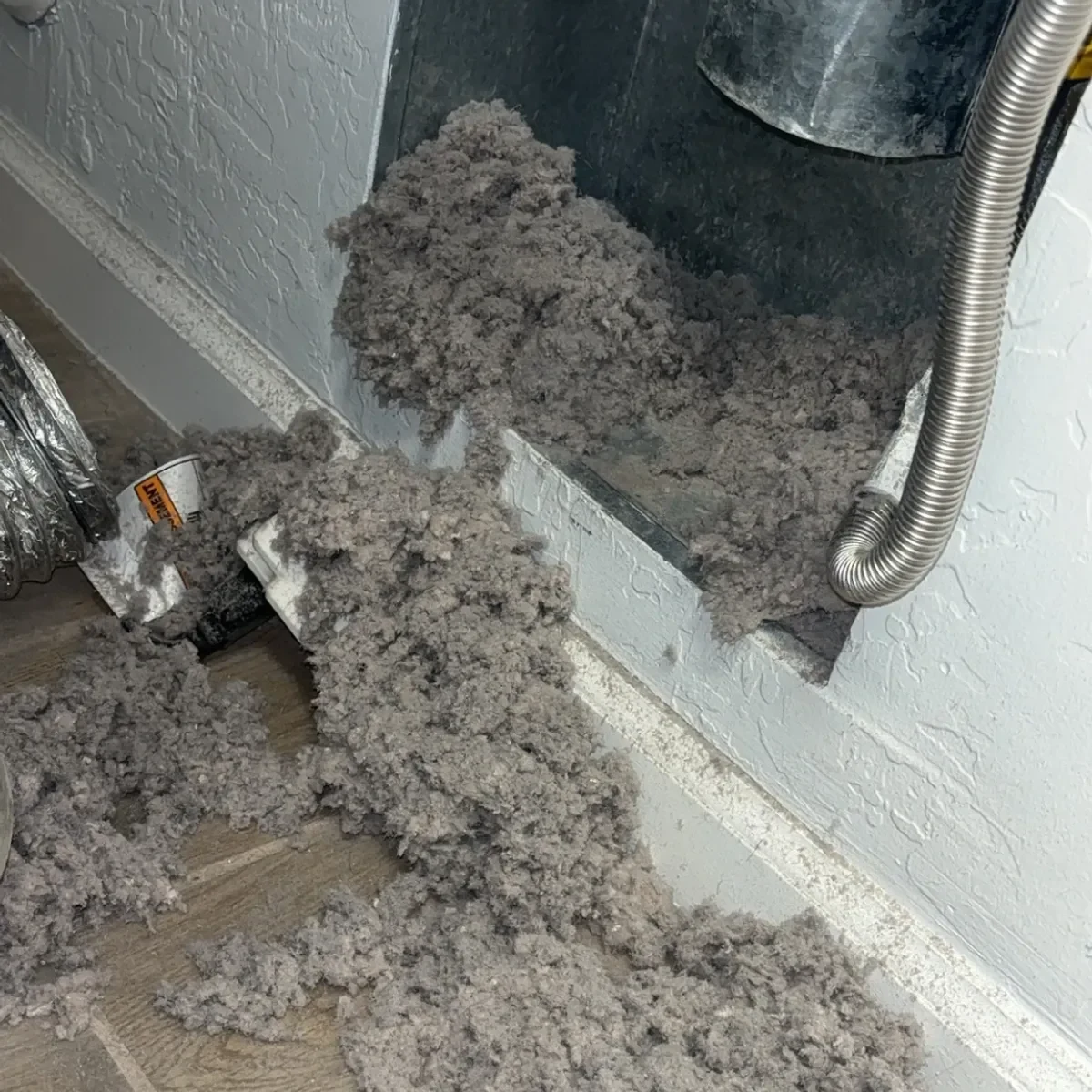
Dust-bound lint, near open ground
On the boundary streets, mineral dust binds with lint and adheres to the pipe wall rather than sitting loose in the airflow. Air alone will not move it. More on that.
A collapsed transition hose
The corrugated foil behind the appliance goes brittle and folds under the weight of the machine leaning on it. The tightest restriction in the entire system ends up three feet from the dryer, and the duct beyond it can be immaculate without helping at all.
Something nesting in the termination
Abrupt rather than gradual. Fine last month, hopeless now, and it is February to May. More likely on the preserve-adjacent streets. Full page.
A run that was extended during a remodel
Common in the continuously rebuilt areas. A renovation moved the laundry or added length, and nobody recalculated the run against what the code allows. It has been struggling since the work was finished.
What it is doing to the appliance
Every dryer carries a thermal fuse meant to cut power before overheating. A restriction has it intervening routinely while the heating element works beyond its intended range, so the machine strains on every load it runs.
The result is an appliance that fails early, and in this town replacing one is not an $800 problem.
Source: National Fire Protection Association, Home Fires Involving Clothes Dryers and Washing Machines.
We will tell you when it is not us
If you ring and the duct turns out to be clear, we are not going to clean it anyway and invoice $99. You get told it is the hose, or the appliance, and charged accordingly or pointed elsewhere. On a property with several machines, if one of them is genuinely clean, that one is not charged.
What we do about it
- Establish the route. We follow where each duct actually goes, inspect the termination, and check the flexible length behind the appliance. On houses this size the run is frequently nowhere near where you would assume.
- Exterior first, machine running. The appliance stays powered throughout so its own exhaust drives what we loosen out and away from the termination, rather than letting it drift back down the run. It scatters lint outside. Clearing that is part of the job.
- Then the interior. Power off, hose uncoupled, appliance drawn clear of the wall. The brush goes in from that end, material comes back toward us, and the vacuum removes it rather than leaving it to resettle.
- Both ends on the long runs. Which, in this town, is most of them. A brush entering from one side never properly reaches the far half of a forty-foot horizontal route.
- Reassembled, run, and shown to you. Every machine goes back where it belongs and gets started, and what came out of each one is left where you can see it.
How often it needs doing
Ten months in an ordinary household. Treat it as scheduled maintenance rather than a reaction to a problem.
- Every 10 months on a main household machine
- Every 4 to 6 months where the house runs full, or where staff and guests put heavy volume through one appliance
- Monthly on commercial equipment
- Before and after a seasonal absence if the property closes up for part of the year
The trap in a house this size is that a secondary machine gets forgotten entirely. A guest house dryer used four times a year still has a duct, still has a termination, and in plenty of properties has never been opened since the place was built.
Common questions
Why does it take two cycles?
Almost always a restriction in the duct. The machine makes hot damp air and it has nowhere to go, so moisture stays in the drum. Less commonly it is a failed element or thermostat, and the checks on this page separate the two before any money is spent.
The machine is showing a code. What does that mean?
Roughly 95 percent of the time it means the duct. The control board tracks cycle length against exhaust temperature and faults out when a restriction drives them out of agreement. Premium appliances do this particularly well, which makes the code a useful diagnostic rather than a nuisance.
Surely an expensive dryer should cope?
It cannot, and this is worth being direct about. A very good machine still cannot push air through forty feet of duct that has not been opened since the house was finished. Build quality affects how long the appliance survives the strain, not whether the strain exists.
How do I tell which it is?
Run it on the no-heat setting and feel the air at the outside termination. Strong steady flow means the duct is clear and the fault is in the appliance. Weak or nothing means the duct.
Could it be a machine we never use much?
Frequently. A guest house or casita dryer that gets used a handful of times a year still accumulates, and nobody notices it declining because nobody is watching. Those are often in worse condition than the main laundry.
What if the checks say the duct is clear?
Then cleaning will not help and we will say so rather than take the money. You want an appliance technician. We do not do appliance repair and nobody pays us for referrals.
Calls answered 7am to 8pm · same-day service usually available
$99 per vent. If it turns out to be the appliance you get told that, not a bill for work that changed nothing.