Dryer vent cleaning in Clearwater Hills
Built into the hillside over six decades, which means the duct went wherever the slope allowed and nobody can tell you where that was. $99 flat per vent, roof terminations included.
Calls answered 7am to 8pm · same-day service usually available
Address, a date and time that suits, and how many machines are on the property.
The gated hillside above Lincoln, on the Camelback slopes
Hillside building makes every house a one-off
Clearwater Hills sits on the Camelback slopes and the homes were built into the terrain rather than onto a graded pad. Multi-level, stepped, with rooms at half-story offsets and garages that sit well below or above the living space.
Everywhere else we work, experience narrows things down before we arrive. Here it genuinely does not. The duct went wherever the structure permitted, once, decades ago, decided by somebody unavailable to ask.
We have traced routes in this neighborhood that ran horizontally through a floor assembly before turning upward, that exited on an elevation invisible from any approach, and that served a laundry room sitting between levels with no obvious relationship to either the roof or an exterior wall.
So it gets worked out on site. The price does not move because a house turns out to be complicated, which would amount to charging people for their own architecture.
Where the material actually collects
Stepped construction changes the physics in a way that matters.
On a conventional two-story, the run goes up and gravity pulls what does not escape straight back down toward the appliance, so the buildup concentrates at the bottom and at the first bend. Predictable, reachable from the dryer end.
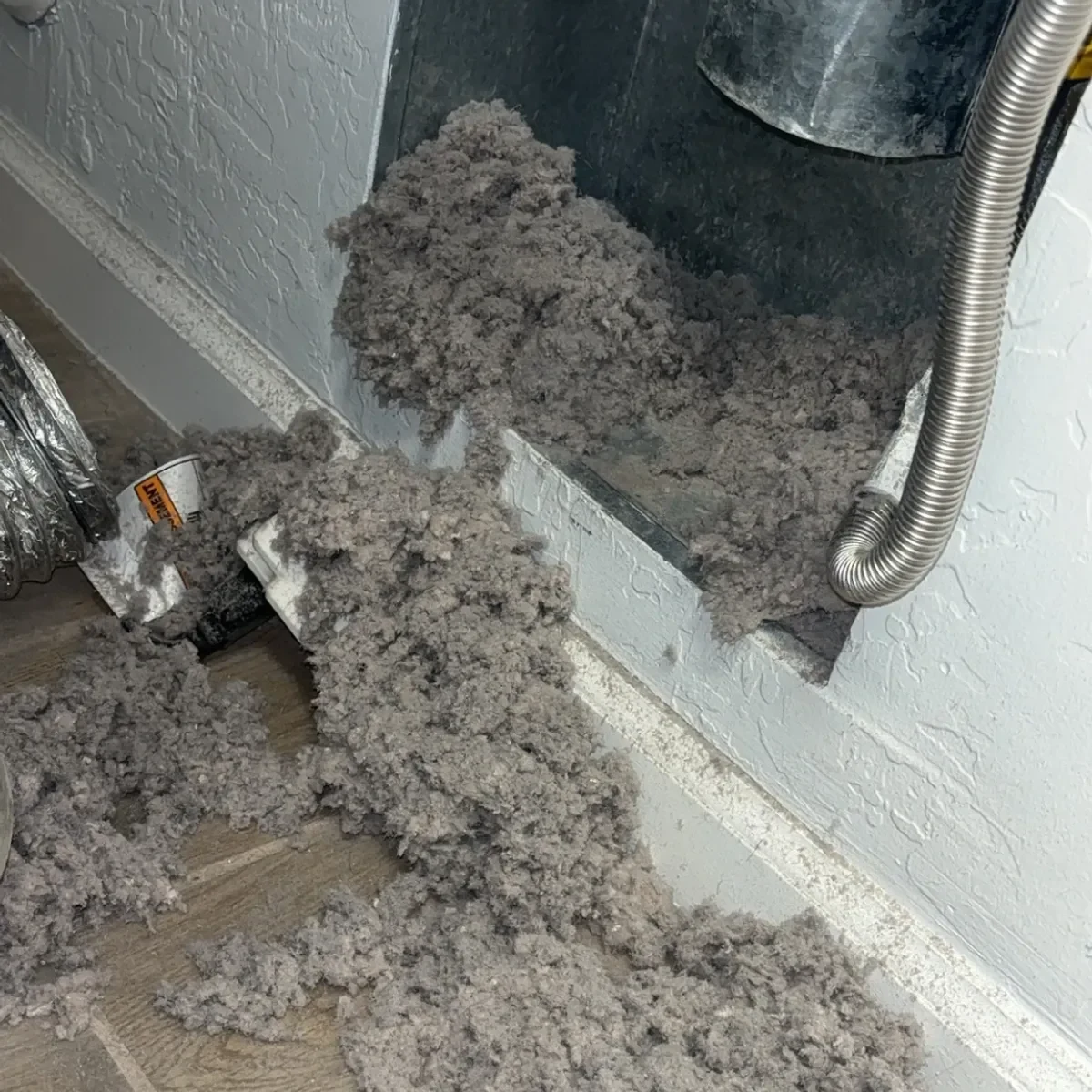
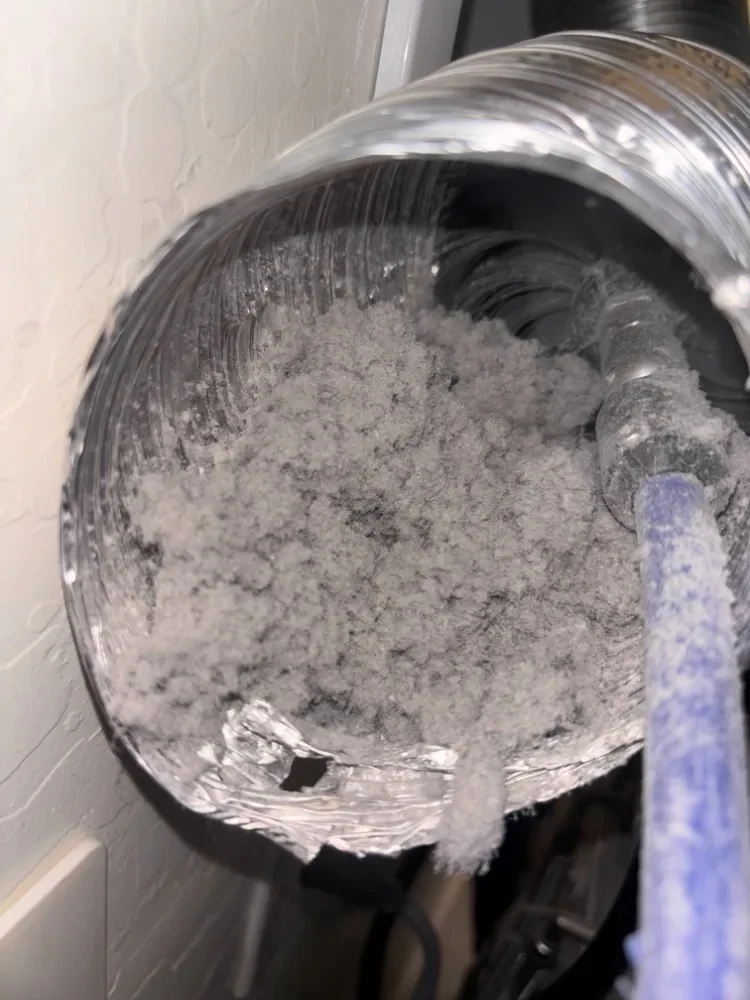
On a multi-level hillside house you get horizontal sections at intermediate heights, and material settles in those and stays there. It does not return to the appliance and it does not carry on to the termination. It sits in the middle of the route, which is exactly the position a single-ended clean fails to address.
A company that brushes from the dryer only will produce a receipt and very little else on a house like this. That is the whole reason we work both ends here by default.
Sixty years of hardware on the older homes
Some of these houses date to the sixties, and while the duct inside the structure generally survives, everything attached to it does not.
- Original flexible transition pieces, brittle, split along the ridges and collapsed under the weight of the appliance
- Exterior flaps that stopped closing decades ago, in full sun the entire time
- Taped joints from an era when that was standard, long since opened
- Terminations in positions nobody has inspected in thirty years, because they are not visible from anywhere people stand
- Renovation work that rerouted a duct without much thought for its length
That last one comes up often in a neighborhood with this much remodelling history. A kitchen or primary suite expansion that pushed the laundry further from the exterior wall added length to a run that nobody recalculated.
Source: National Fire Protection Association, Home Fires Involving Clothes Dryers and Washing Machines.
How the job runs here
- Establish the route. We follow where each duct actually goes, inspect the termination, and check the flexible length behind the appliance. On houses this size the run is frequently nowhere near where you would assume.
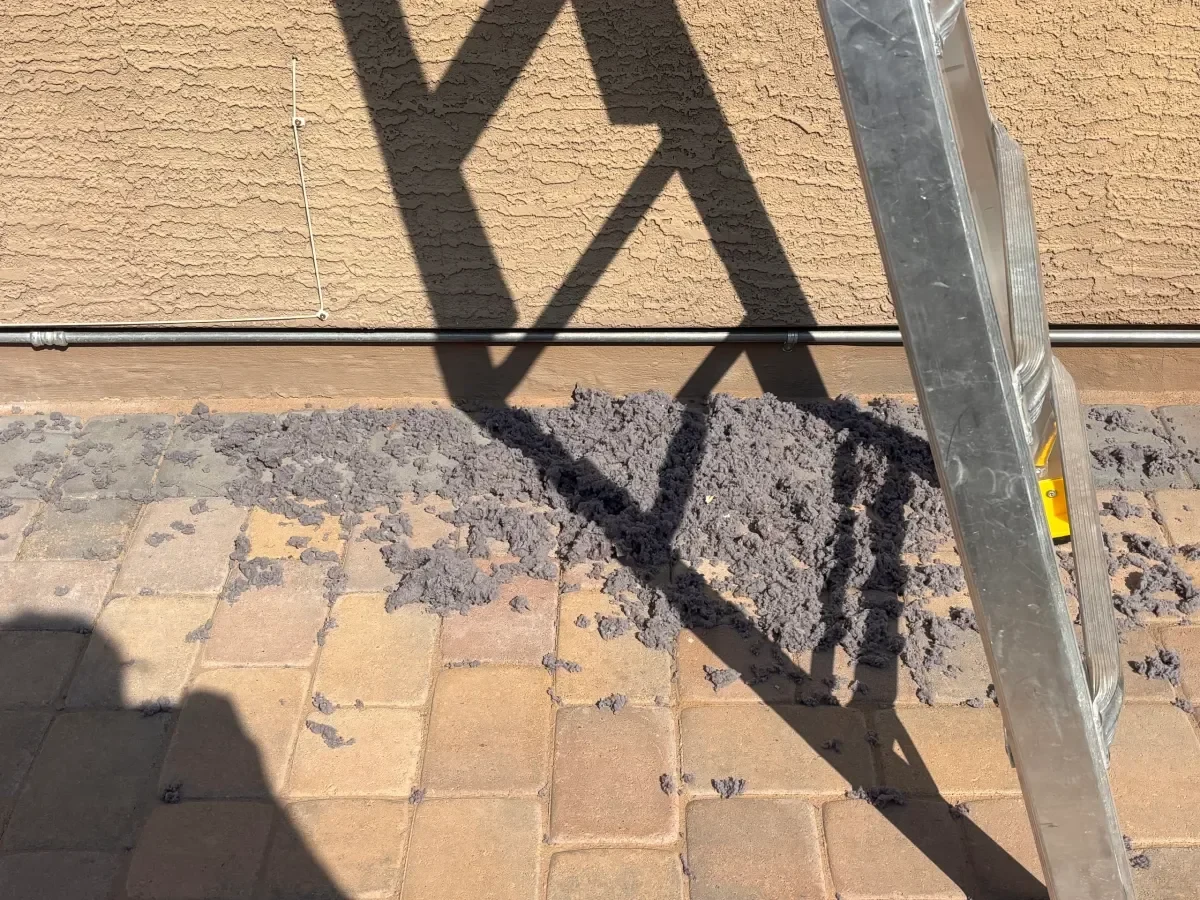
- Exterior first, machine running. The appliance stays powered throughout so its own exhaust drives what we loosen out and away from the termination, rather than letting it drift back down the run. It scatters lint outside. Clearing that is part of the job.
- Then the interior. Power off, hose uncoupled, appliance drawn clear of the wall. The brush goes in from that end, material comes back toward us, and the vacuum removes it rather than leaving it to resettle.
- Both ends on the long runs. Which, in this town, is most of them. A brush entering from one side never properly reaches the far half of a forty-foot horizontal route.
- Reassembled, run, and shown to you. Every machine goes back where it belongs and gets started, and what came out of each one is left where you can see it.
How often it needs doing
Ten months in an ordinary household. Treat it as scheduled maintenance rather than a reaction to a problem.
- Every 10 months on a main household machine
- Every 4 to 6 months where the house runs full, or where staff and guests put heavy volume through one appliance
- Monthly on commercial equipment
- Before and after a seasonal absence if the property closes up for part of the year
The trap in a house this size is that a secondary machine gets forgotten entirely. A guest house dryer used four times a year still has a duct, still has a termination, and in plenty of properties has never been opened since the place was built.
Questions from Clearwater Hills owners
Is there a surcharge for Paradise Valley?
There is not, and that is deliberate. It is $99 per vent here and $99 per vent in every other town we work. The address does not get its own pricing. Where the figure rises is simply if there is more than one dryer on the property, and each additional one is the same $99 rather than a premium.
What happens when I ring?
We take the address, a date and time that suits, and how many machines are on the property. That last one matters mainly so we know how long to allow. You get the price on that call, there is no estimate visit, and most properties are fitted in within the same week. Phone is answered 7am to 8pm.
How often does it need doing?
Ten months on a main household machine. Four to six where the house runs full or the property sits near open ground and takes more dust. Monthly on commercial equipment. And if the property closes for part of the year, before or shortly after that absence rather than mid-season.
We have several dryers. Do they all need it?
Each has its own duct and its own termination, so each needs its own attention. The secondary ones are usually in worse condition than the main laundry, because light use means nobody notices them declining and plenty have never been opened since construction. All of them get done in the same visit.
How do I know whether it is even needed?
Two free checks. If the appliance has put up an error code, that points at the duct roughly 95 percent of the time. Second, run it on the no-heat setting and feel the air at the outside termination. Strong steady flow means clear, weak or nothing means restricted. Premium appliances are not exempt from either.
Can you work with our property manager?
Yes, and a good share of our work here is arranged that way. We deal with access and timing directly with them, and the invoice goes wherever you want it.
Elsewhere in Paradise Valley
Camelback Country Estates · Mummy Mountain and Cheney Estates · Palo Cristi and Sundown Estates · Casa Blanca Estates and Judson · Tatum Canyon and Finisterre
Calls answered 7am to 8pm · same-day service usually available
$99 per vent, roof access included. Call or text.